
Chesterfield County Court Records After a Jail Arrest
After an arrest in Chesterfield County, a person may be transported to the Chesterfield County Detention Center at 319 Goodale Road. Jail staff under the local sheriff and detention-center structure handle intake, booking, custody classification, and the current confinement record. Sheriff Cambo Streater's office is tied to the jail side of the process, while the court record begins as arrest paperwork moves into the court system. In South Carolina, prosecutors are called solicitors. Chesterfield County is served by the Fourth Circuit Solicitor's Office, which also serves Darlington, Dillon, and Marlboro counties. That office prosecutes many criminal matters after arrest, especially General Sessions cases, but it does not operate the jail roster.
The distinction matters because a booking charge is not always the court charge. A roster or jail inmate records search can confirm current custody or recent booking detail. A jail mugshots request may address booking photos and booking reports. The court record is different: it tracks prosecutor and court action after the arrest, including filed charges, bond orders, court dates, warrants, amendments, dismissals, pleas, verdicts, and sentencing. A person may appear on the county roster before a searchable court case appears in the Public Index.
The county's own booking-records notice creates a practical sequence. For very recent arrests, the Sheriff's Office says booking records are not immediately available online and directs callers to the Detention Center at (843) 623-3385 for possible arrests within the past 12 hours. For older arrest and court information, the notice points users to the South Carolina Judicial Branch Public Index. That sequence keeps the search grounded: start with custody when the question is whether someone is in jail now, then move to court records after the court has had time to receive or file the case.
The county-specific portal for filed cases is the Chesterfield County Public Index.
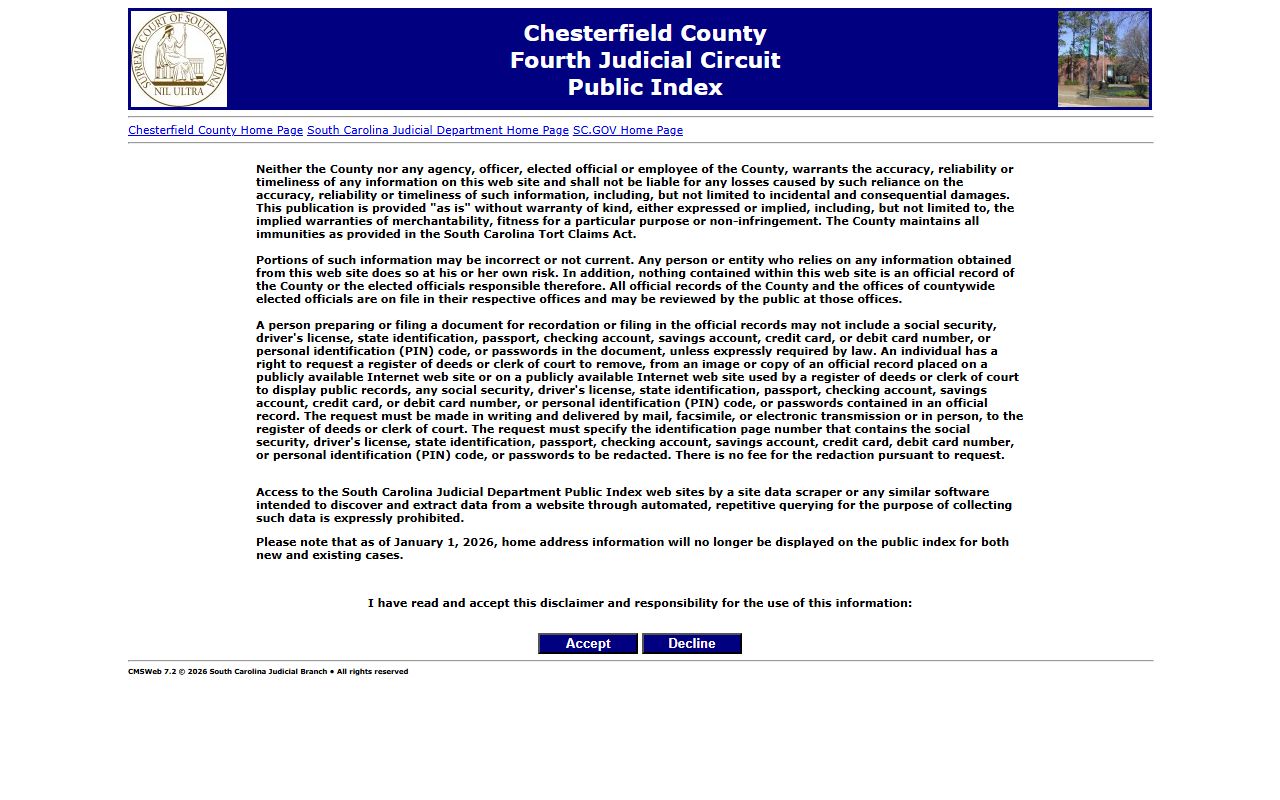
The Public Index screenshot reflects the court side of the arrest-to-case path, not the jail's live custody roster.
How to Find Court Records After an Arrest
The official online court channel is the South Carolina Judicial Branch public-index system, with a Chesterfield County Public Index page for county-specific records. The state case-record search explanation at sccourts.org points users toward public court records by county and court. The Chesterfield Public Index is the better starting point when the arrest happened in Chesterfield County and the reader needs the charges or case status filed after booking.
| Field Label | Type | Required | Options / Format Notes |
|---|---|---|---|
| County | Dropdown or county portal | Yes by portal | Use the Chesterfield County Public Index for Chesterfield records. |
| Court agency / court type | Dropdown or link set | Context dependent | Public Index commonly separates Common Pleas, General Sessions, Family, Magistrate, and Municipal indexes where available. |
| Case Number | Text | No | Best when known from court paperwork, a warrant, ticket, bond document, or prior case notice. |
| Party Name | Text | No | Search by defendant last name and first name. Try broader spelling if no result appears. |
| Date range | Date fields | No | Use an arrest date, filing date, or court date range when known. |
| Search / Submit | Button | Yes to run search | The button label can vary by index page or court selection. |
- Search Citizen Connect first if the immediate question is whether the person is currently confined in the Chesterfield County Detention Center.
- Write down the exact name spelling, booking date, arresting agency, warrant number, and booking charge if those details are visible.
- Open the Chesterfield County Public Index and search by defendant name. If spelling is uncertain, try last name only or last name plus first initial.
- Search by case number when a ticket, warrant, bond form, or court notice provides one. Case numbers are more precise than names.
- Review the charge list, court agency, case history, hearing dates, bond entries, and disposition fields for each matching case.
- Compare the roster charge to the court charge. The solicitor or court may amend, reduce, dismiss, enhance, or replace charges after arrest.
- For sealed files, older paper files, or documents that are not viewable online, contact the Clerk of Court or the appropriate magistrate or municipal court.
SLED CATCH at catch.sled.sc.gov is South Carolina's official criminal-history search portal. It can be useful when a statewide criminal-history record is needed, but it is not a custody roster and does not replace the Chesterfield County Public Index for case-level court records after an arrest. SLED searches may carry fees and identity limits, so they should not be treated as a free live jail lookup.
The SLED CATCH portal is a separate statewide criminal-history tool.
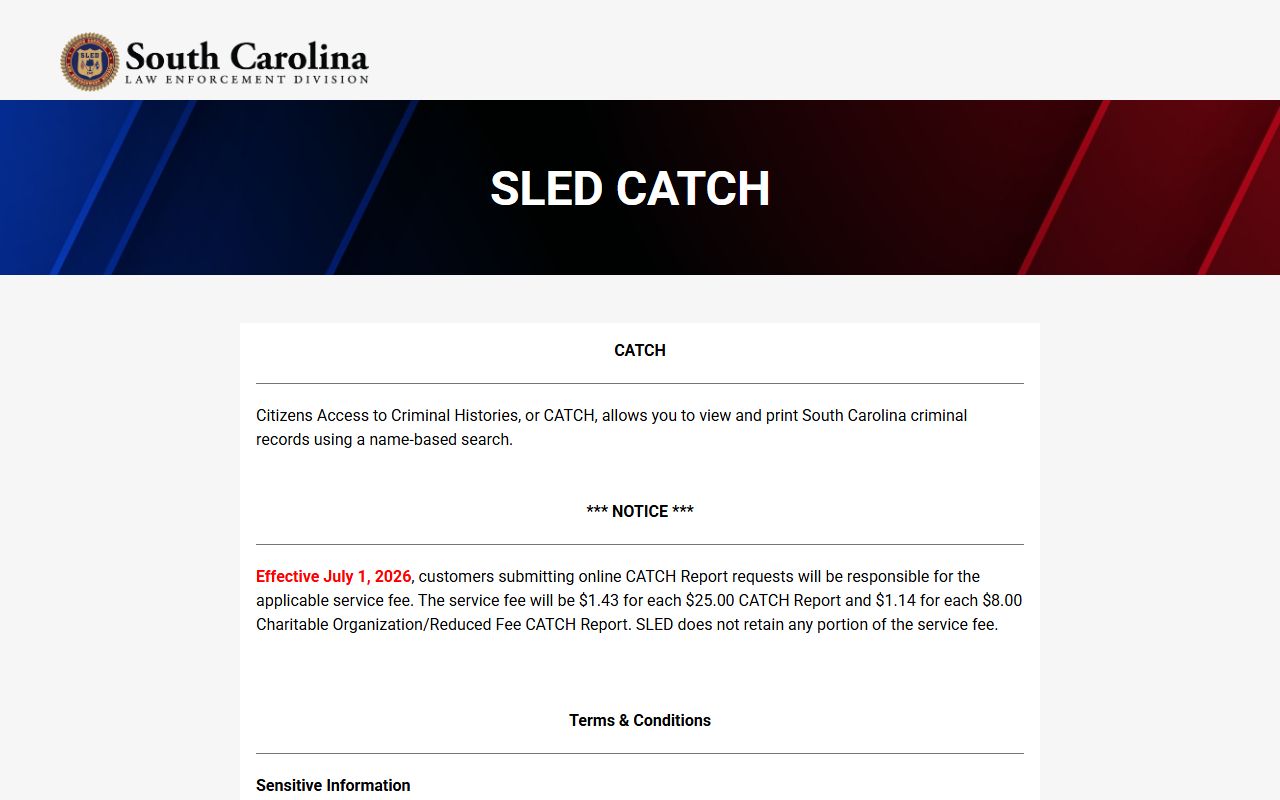
Use SLED CATCH for criminal-history research, while using the Chesterfield Public Index for filed court cases and Citizen Connect for current jail custody.
Court Records After an Arrest: Complaint, Information, and Indictment
The path from arrest to court filing can begin with an arrest warrant, citation, direct booking paperwork, or complaint. Once the case moves forward, the formal charging document controls what the court record says. In Chesterfield County, lower-level matters may be handled in magistrate or municipal court, while serious criminal prosecutions may move through General Sessions with solicitor review. The filing type depends on the offense, court level, and South Carolina criminal procedure.
| Charging Document | Who Uses or Files It | What It Does | Why It May Differ From Booking |
|---|---|---|---|
| Complaint or warrant paperwork | Law enforcement and court process | States the accusation that supported arrest or early court handling. | The initial allegation may be rewritten, clarified, or replaced after review. |
| Information or solicitor filing | Prosecutor / solicitor | Frames the charge the prosecution intends to pursue in court. | The solicitor can amend, reduce, dismiss, or add charges based on evidence and law. |
| Indictment | Grand jury process for eligible cases | Allows serious charges to proceed in the appropriate court. | An indictment may use a charge label or count structure different from the jail roster. |
The Fourth Circuit Solicitor's Office reviews and handles prosecution after arrest, but it does not maintain Citizen Connect, the jail booking records page, or the Chesterfield County Detention Center roster. That division of responsibility is why court records after a jail arrest should be searched separately from the booking record.
Charge Status in Court Records After Jail Arrest
Charge status changes as a case moves. A booking charge may be only the first public label attached to the arrest. After first appearance, solicitor review, grand jury action, plea negotiations, court orders, or trial, the same event may have a different court record. Always read each charge line separately, because one count may be pending while another is dismissed or resolved.
| Status | What It Means | Search Note |
|---|---|---|
| Pending | The case or charge is still open and has not reached final disposition. | Check future hearing dates and bond conditions. |
| Amended | The charge has changed from the original version. | Compare the amended charge to the roster charge before drawing conclusions. |
| Reduced | The charge has been lowered to a lesser offense. | The final charge may carry different penalties than the arrest charge. |
| Dismissed | The charge ended without conviction. | A dismissal is not the same as automatic expungement or internet removal. |
| Nolle prosequi | The solicitor declined to continue prosecuting that charge. | Look for whether other counts remain active. |
| Guilty / conviction | A conviction was entered by plea, trial, or court disposition. | Review sentence fields and related conditions. |
| Not guilty / acquittal | A trial result was entered in the defendant's favor. | Ask the court or counsel about any record-restriction steps. |
| Bound over | A lower-court matter moved toward a higher court. | Search General Sessions as well as the earlier court index. |
Bond, First Appearance, and Court Records After an Arrest
After booking, the person may have a first appearance or bond hearing before a magistrate, depending on the charge and timing. South Carolina Title 17, Chapter 15 governs bail and recognizance, including pretrial release and conditions. Bond information can appear in jail records, court records, or both, but the court controls the legal bond order. The jail can often confirm current custody and whether a hold blocks release. The court record is the better place to check the formal bond action tied to the case.
| Bond Type | How It Works | Chesterfield Search Note |
|---|---|---|
| Personal recognizance / own recognizance | Release based on a signed promise to appear and follow conditions. | Verify conditions in the court record and with the jail before relying on release status. |
| Cash bond | Money is paid as directed by the bond order. | No Chesterfield-specific payment schedule was located, so call the Detention Center before bringing funds. |
| Surety bond | A licensed South Carolina bondsman may post a surety bond when allowed. | Confirm the jail or court will accept the surety paperwork before assuming release can occur. |
| Property bond | Property may secure release if accepted under state and court rules. | Ask the court what documentation and approval are required. |
| No-bond hold | Release is blocked until further court action or another hold clears. | A warrant, probation or parole hold, ICE detainer, or other agency hold can prevent release even when a local bond exists. |
A practical bond check starts by confirming the person is in the Chesterfield County Detention Center through Citizen Connect or by calling (843) 623-3385. Ask whether bond has been set, the exact amount, the bond type, where bond is accepted, what hours and payment methods apply, whether government ID is required, and whether any hold prevents release. Release is not instant after posting because jail staff must process paperwork, verify holds, and complete release steps.
Warrants That Lead to an Arrest
No official Chesterfield County Sheriff's active-warrant search page was located in the research sweep. For a possible active warrant, use a fallback chain rather than relying on a missing public database. Call the Sheriff's Office at (843) 623-2101 for general routing, call the Detention Center at (843) 623-3385 if the warrant may already have led to booking, and search the Chesterfield County Public Index for bench warrants, failure-to-appear entries, and orders tied to filed cases.
An arrest warrant authorizes law enforcement to arrest a person on a criminal allegation. A bench warrant usually comes from a judge, often after failure to appear or failure to follow a court order. A fugitive warrant, probation warrant, parole warrant, or outside-agency hold may affect release from the Chesterfield County Detention Center. A person with an active warrant may be arrested, so practical warrant questions should be handled through the issuing court, counsel, or the appropriate agency before appearing at the jail.
Court Charges After Arrest vs. Convictions
Being arrested and charged is not the same as being convicted. A charge is an accusation filed or tracked in a court case. A conviction is a final result after a guilty plea, trial verdict, or other court disposition that creates a conviction entry. Court records after a jail arrest can show both types of information, so the status field and disposition date matter as much as the charge label.
| Charge | Conviction | |
|---|---|---|
| Stage | Accusation after arrest or court filing. | Final result by plea, verdict, or qualifying court disposition. |
| Proof level | Initial court process may begin from probable cause or formal accusation. | Criminal conviction requires proof beyond a reasonable doubt or a valid guilty plea. |
| Record meaning | Shows what was alleged or filed. | Shows legal responsibility for the offense as resolved by the court. |
| Can change? | Yes. Charges may be amended, reduced, dismissed, or replaced. | Post-disposition relief may exist, but it requires a legal basis and court process. |
| Where to verify | Public Index case details, court clerk, and solicitor records when public. | Final disposition and sentence entries in the court record, plus SLED criminal-history records when appropriate. |
Sealed vs. Expunged Arrest Records in South Carolina
South Carolina law can restrict public access to some records after dismissal, acquittal, juvenile handling, eligible expungement, or a court order. Title 17, Chapter 30 and related expungement provisions address criminal-record handling and pathways that can affect public access. Title 63, Chapter 19 treats juvenile-justice records differently from adult jail and court records. A dismissal or nolle prosequi entry does not automatically erase every public trace; the person should ask the court, solicitor, or counsel which record-clearing process applies.
| Sealed | Expunged | |
|---|---|---|
| Basic effect | Public access is limited or hidden by court order or law. | Eligible records are removed, destroyed, or treated as cleared under the governing order. |
| Common reason | Juvenile confidentiality, protected information, sealed case materials, or court-ordered restriction. | Eligible dismissal, acquittal, or other outcome covered by South Carolina expungement law. |
| Who can confirm | The court that controls the case file. | The court, solicitor, and agency that received the expungement order. |
| Online effect | The public index may hide details or omit the case from ordinary search. | Public systems may remove or suppress eligible entries after processing. |
| Important limit | Some government or law-enforcement access may remain. | Expungement does not guarantee instant removal from cached search results or private copies. |
Background Check Considerations
Public court records, roster entries, and criminal-history searches serve different purposes. The Public Index shows case-level court activity. Citizen Connect shows current county jail confinement. SLED CATCH is the statewide criminal-history portal. None of these should be blended into an employment, housing, insurance, credit, or tenant-screening decision unless the user is following the law that governs consumer reports and official record verification.
Important: This site is not a consumer reporting agency under the Fair Credit Reporting Act and is not for FCRA-covered decisions.
Restricted Court Records After an Arrest in Chesterfield County
South Carolina FOIA, Title 30, Chapter 4, supports public inspection or copying of non-exempt public records, subject to fees, response rules, and exemptions. Section 30-4-40 includes exemptions that may limit law-enforcement, privacy-sensitive, security-sensitive, medical, juvenile, victim-related, sealed, or expunged information. Court systems can also restrict records by rule or order. If a Chesterfield County arrest involved a juvenile, sealed charge, active investigation, protected victim information, or expunged disposition, the public index may show less than the underlying agency file or may show nothing at all.
For records not available online, the practical route depends on the record type. Current custody and recent booking questions go to Citizen Connect or the Detention Center. Filed court charges go to the Chesterfield County Public Index or the relevant court clerk. Criminal-history searches go through SLED CATCH. Prosecutor-specific case questions in the circuit-court context may involve the Fourth Circuit Solicitor's Office. Each office controls a different record, so one missing result does not prove that no arrest, charge, warrant, or disposition exists.